
Richland Parish Criminal Docket Searches
The online starting point is ClerkConnect Richland. It is billed as a civil, criminal, and land-record inquiry. Its criminal search fields and sample results sit behind a login. Search and print functions are subscription features. So treat this as an authenticated, possibly paid route rather than a proven free public name search.
Enter the exact case number first when you have it. Pick Richland and the criminal category in your session. Then match the caption, filing date, and division before trusting any result. Keep the event list and the document image separate in your mind. A missing image does not prove the filing never happened. It may simply be offline or need a separate request from the clerk.
For a statewide option, the eClerksLA Statewide Portal runs through the Louisiana Clerks' Remote Access Authority. The login gate requires an email and password. Links let you register, reset a password, or resend confirmation. Record types, fees, and image coverage depend on your account state. No unauthenticated Richland criminal result is available to browse.
- Identify whether the case belongs in Fifth Judicial District Court, a Justice of the Peace court, a mayor's court, or federal court.
- Try the ClerkConnect Richland inquiry or the statewide eClerksLA route with the case number and the available record category.
- If no result is available, ask the Richland Parish Clerk of Court for the public register, a minute entry, or a specific order.
- Confirm the next setting with the assigned court division because a docket event may not be the current hearing date.
Note: ClerkConnect's public fields, result format, prices, and document coverage require an account to see.
Richland Parish Criminal Docket Calendar Pattern
The Fifth Judicial District Court calendar sets the rhythm. Most Richland Parish criminal docket settings follow it. Misdemeanor arraignments, motions, and trials generally land on Tuesdays during regular court weeks. Felony arraignments, motions, and trials generally land on Wednesdays at 9:30 a.m. Jury weeks are held for criminal petit-jury trials and specially ordered bench trials.
Remember that these are patterns. They are not a calendar row for your case. A fixing order, continuance, holiday, jury term, special order, or division assignment can move any setting. The calendar explains the schedule. But the current docket or a quick inquiry with the clerk is the safer way to confirm one criminal court date. The official calendar page shows the court's regular schedule.
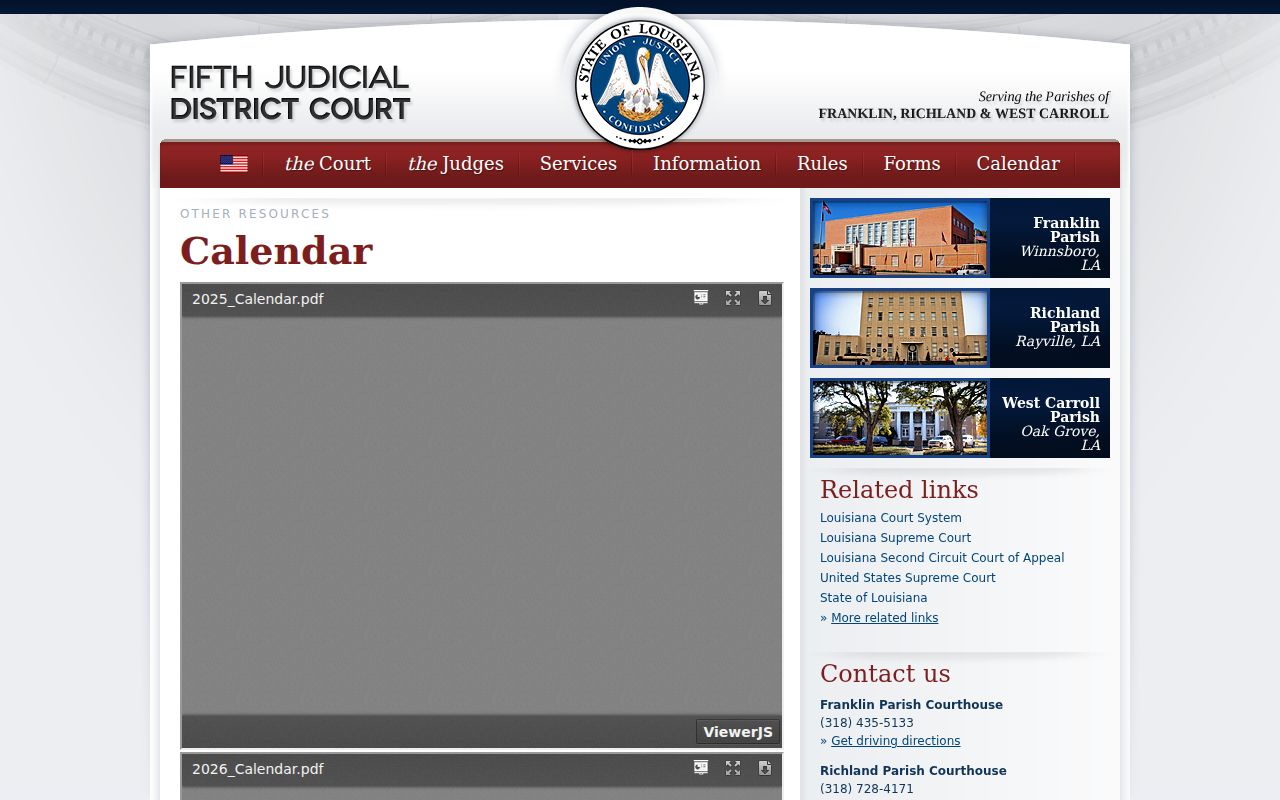
Its weekly categories explain why a court date can fit the pattern and still need direct confirmation with the clerk.
Inside a Richland Parish Criminal Docket
A criminal docket is a chronological register, not a verdict summary. In a Fifth Judicial District Court case in Richland Parish, look for the docket number, filing date, division, judge, charge information where public, status, setting, and later disposition. These are the fields local rules and Louisiana's criminal-minute-entry requirements call for, not a promise about how ClerkConnect arranges its display.
| Case number | Identifies the case and is the strongest search key when available. |
|---|---|
| Division and court | Shows the assigned 5JDC division and helps route a setting question. |
| Charge and status | May show the charge, amendment, dismissal, plea, or other public procedural status. |
| Minute entry | Records an action, hearing, or ruling; it is distinct from a full filed document. |
| Setting | Shows a date, time, and hearing type when the entry provides them; check for a later reset. |
Words matter here. "Filed" does not mean granted, "set" does not mean heard, and "continued" does not mean dismissed. Read the latest entry and any public order before you conclude anything about the case.
Richland Parish Criminal Docket Allotment
Fifth Judicial District Court assigns criminal cases through a three-division allotment rule. Under local Rule 14.0, one of three division balls decides where a case lands. Related charges from the same investigation or series generally stay together in one division. The rule also covers charges intended within 180 days. Moving a case takes a written order signed by both judges. That is why related case activity often stays put. It seldom spreads across the court.
- Allotment
- The local assignment of a filed criminal case to a court division.
- Arraignment
- A criminal appearance that addresses the charge and plea process; it may be heard by a presiding judge as called.
- Status conference
- A pretrial case-management setting, not necessarily the trial itself.
- Fixing
- The local process that places a matter on a court date through the assigned division.
Preliminary matters, arraignment, and bond reduction can be heard before a division other than the final assignment. So the division field helps, but read it with the event text and the current setting. It is not a shortcut to the case outcome.
Criminal Case Stages on the Docket
Most Richland Parish criminal docket activity follows a sequence. Any step can be skipped, added, or moved. The filing opens the court case. From there, entries may record arraignment, motions, a status conference, plea, trial setting, verdict or other disposition, and sentencing. The district's local procedure also permits a waiver of formal arraignment form. An entry may reflect that paperwork instead of a courtroom arraignment.
Filing → Arraignment → Pretrial → Plea or Trial → Disposition → Sentencing
A docket gives you the procedural trail, nothing more. A plea or sentencing entry is not a certified judgment or transcript. When the precise document, seal, or certified form matters, ask the clerk for that public record.
Richland Parish Criminal Minute-Entry Fields
Louisiana R.S. 13:5992 opened the door to electronic criminal minute entries. For qualifying matters filed on or after January 1, 2020, the public must be able to reach minute entries or summaries through the LCRAA route. The statute's exceptions apply. The required summary covers the basics a reader of a Richland Parish criminal docket would look for: arrest or summons, custody or bail, charge changes, motions and status hearings, trial or adjudication, guilt decisions, and sentencing details. Each summary must also carry the proceeding date plus the judge, prosecutor, and defendant.
The statute has limits. It does not demand that every scanned filing go online. Older cases are outside its scope too. Traffic violations are expressly excluded from the criminal minute-entry requirement. When you need an underlying order, an image, or a certified copy, ask the Richland Parish Clerk of Court. The clerk can tell you what public version exists. A copy fee may apply. The Legislature's official statute page spells out the public minute-entry rule and its exclusions.
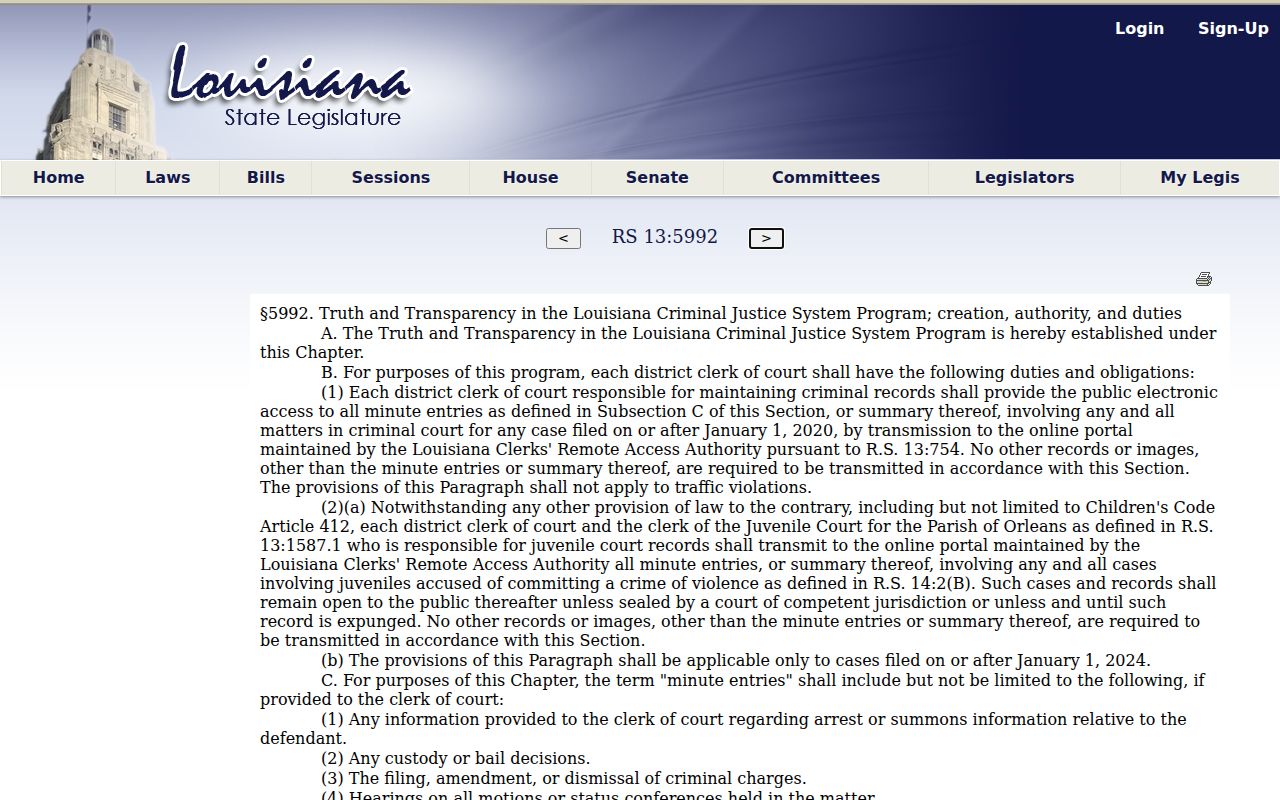
The statutory list works well as a checklist for a public summary. Treat it as a guide, not proof that every criminal case file has been fully digitized in Richland Parish.
Richland Parish Criminal Docket Courts
The Fifth Judicial District Court is where Richland Parish criminal cases are tried. The Richland Parish Clerk of Court keeps the district's civil and criminal proceedings. The court serves three parishes: Richland, Franklin, and West Carroll. It works through Divisions A, B, and C. Not every appeal stays local, though. Appeals from the district court go to the Second Circuit Court of Appeal. It runs its own separate appellate docket.
| Court or venue | Likely criminal record | Best starting point |
|---|---|---|
| Fifth Judicial District Court | Felonies and district-court misdemeanors | Richland Clerk, ClerkConnect, or 5JDC contact |
| Justice of the Peace court | Limited matters within JP authority | Appropriate ward JP office |
| Rayville, Delhi, or Mangham mayor's court | Municipal ordinance or local traffic matter | Municipal clerk or city-linked vendor route |
| Western District of Louisiana | Federal criminal proceeding | PACER/CM-ECF, not the parish clerk |
Start with the venue that issued the charge. A municipal citation screen, a JP inquiry, and a district criminal register are different records. Different offices hold each one. For Richland's ward-level Justice of the Peace contacts, the Louisiana Attorney General Justice Court directory is the place to look. A district appeal sits somewhere else entirely, with the Second Circuit docket.
Richland Parish Criminal Docket Search Gaps
An empty docket search is a prompt, not a verdict. Check the venue before drawing any conclusion. The case may sit elsewhere. It could be in a city mayor's court, a Justice of the Peace court, the federal Monroe Division, an archive, or a restricted category. A miss can also come from spelling. An unrecognized case format is another cause. So are a closed archive and ClerkConnect's public fields staying locked without an authenticated session.
The first fallback is the clerk's civil and criminal divisions at the Richland Parish Courthouse. Call the clerk's directory line at (318) 728-7000. You can also call the court's general line at (318) 728-4171. Name the case number. Give the date or date range, the event or document type, and whether a plain or certified copy is needed. Call before counting on a public courthouse terminal, since the clerk does not advertise one.
Walk-in requests go to 708 Julia Street, Suite 103, Rayville, Louisiana 71269. Mail goes to P.O. Box 119, Rayville, LA 71269. The clerk lists fax (318) 728-7020 and email richlandparishcc@bellsouth.net in the official directory. A Records Document Request form is also available. Confirm whether the office takes requests by mail, fax, or email, which copy type you want, and what fee applies. Clerk hours run Monday through Friday, 8:30 a.m. to 4:30 p.m. The office closes on legal holidays.
The official ClerkConnect Richland landing page identifies the inquiry service for online docket searching.
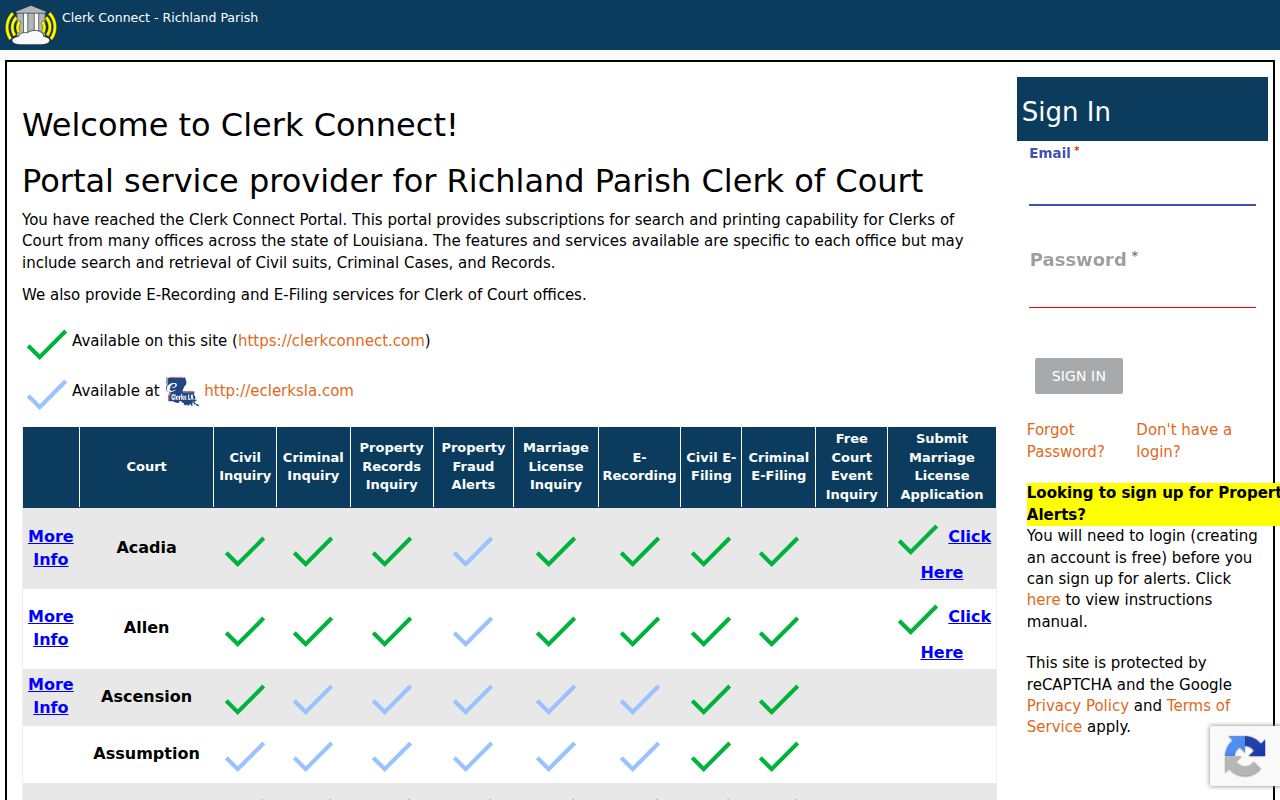
Because ClerkConnect's public fields can stay behind a login, the clerk and written-request channels remain the reliable path when online access does not produce a usable Richland Parish docket result. A phone call or a mailed form simply reaches records the portal will not show.
Note: A specific request for a public docket or minute entry gets better results than a broad request for everything tied to a name.
Richland Parish Traffic Docket Boundary
Traffic is where most people slip. The R.S. 13:5992 electronic minute-entry rule does not cover traffic violations at all. Where a local traffic matter lands depends on the issuing authority and the charge: a mayor's court, a Justice of the Peace court, or the district court. A city payment lookup can help you spot a citation. But it is not proof of the complete municipal register or the final outcome.
For a traffic citation, start with the court named on the ticket. From there, use the municipal clerk, the applicable JP, or the district custodian. See the separate Richland Parish Traffic Court information. It explains the local court-record distinction, and it keeps a citation from being treated as a district criminal docket by default.
Access Rules for Criminal Dockets
Louisiana's public-records baseline lives in R.S. 44:1. That statute broadly defines public records while leaving court-specific confidentiality and sealing rules in place. Going to the right holder of the record matters. For Fifth Judicial District Court records, begin with the Richland Parish Clerk of Court; for records held elsewhere, begin with the municipal clerk or the federal court.
Public access has limits. R.S. 13:754 authorizes Louisiana's remote-access framework and may allow user fees. R.S. 13:5992 covers qualifying criminal minute-entry summaries. Children's Code art. 412 makes juvenile court records confidential except as authorized.
Some material simply will not be there. Sealed, expunged, juvenile, and protected records may be omitted or limited in a docket search. Ask the clerk about release options. A public docket entry, a redacted copy, or proof of filing may be possible. A restricted record is never an invitation to work around a court order or confidentiality rule.