
Richland Parish Civil Docket Searches
Two online doors lead into Richland Parish civil records. Both want a login. ClerkConnect Richland is the official-linked inquiry route for civil, criminal, and land records, but it runs on an account basis. No public search fields or free document images greet a casual visitor. So plan on registering rather than browsing. Even then, do not assume every civil case or filing image will surface.
The statewide layer works the same way. The eClerksLA Statewide Portal opens on a login and registration screen. It is not an open Richland docket search form. Once inside, enter the case number if you have it. Pick the record type the system offers. Then confirm the filing date, case style, and division. A login screen alone promises neither a free public name search nor a guaranteed civil image for Richland Parish.
If neither remote route yields the register you need, go to the source. The clerk of the Fifth Judicial District Court remains the office that keeps the civil file itself. Louisiana's LCRAA overview describes secure remote access for participating parish clerks, though exact Richland Parish coverage and user fees are questions only live access can answer.
- Confirm that the case belongs in Fifth Judicial District Court rather than a Justice of the Peace or municipal venue.
- Search ClerkConnect or eClerksLA with the exact docket number when an authenticated account permits it.
- Compare the case style, allotment division, and filing date before treating a result as the right case.
- Ask the Richland Parish Clerk of Court for a public docket, order, judgment, or copy if online access is incomplete.
Richland Parish Civil Docket Allotment
How does a Richland Parish civil case land in one division instead of another? Local Rule 9.3 answers that for Fifth Judicial District Court. Ordinary civil cases are randomly allotted from a container of 15 balls. Five go to each of Divisions A, B, and C. The allotment entry lists the docket number, case style, division, and allotment date. That record matters. It tells you which division will control later settings and orders.
Family and domestic cases draw from a different container. It holds 12 balls, used mainly for Divisions B and C. Division A steps in when there is a conflict. A case does not drift freely out of its original division. The local rules spell out the narrow situations where an assignment may change. So a different court name in a later document is not proof of an ordinary transfer.
- Allotment
- The court's local assignment of a case to a division.
- Case style
- The caption identifying the parties or the matter.
- Fixing form
- The local form used to request a trial date after the answer stage.
- HOC
- A Hearing Officer Conference used in the specialized domestic track.
Inside a Richland Parish Civil Docket
Think of a Richland Parish civil docket as a running log of court activity. It can show the docket number, filing date, case style, party roles, and assigned division. From there it tracks the petition, service, answer, motions, orders, settings, and any eventual judgment or dismissal. One caution: the register can point to a document without displaying it. A listed event is one thing. The actual court paper is another. A copy may still have to come from the clerk.
| Docket number | The case identifier used by the clerk and assigned court division. |
|---|---|
| Allotment | Shows the division and date of the civil assignment. |
| Filing event | May record a petition, answer, motion, exception, or service action. |
| Setting event | May show a fixing form, motion hour, pretrial, HOC, or trial setting. |
| Disposition | Can show judgment, nonsuit, dismissal, settlement, appeal, or later order. |
A docket entry is a record of an event, not its result. A motion filed is not a motion granted, and a scheduled setting is not the hearing outcome. When the exact wording of an order matters, ask the clerk for the public document or a certified copy rather than guessing its effect from the register title.
Richland Parish Civil Docket Fixing Forms
Fifth Judicial District Court Rule 9.14 sets the next step. It applies once an answer lands on the docket. A party who wants a trial date asks the clerk for a fixing form. The form gets filled out. Then it returns to the assigned judge for signature. The signed order that follows explains why a hearing date shows up on a civil docket. It also explains why a standing weekly pattern can't confirm a specific case date on its own.
Most civil contested and uncontested matters in Richland Parish are heard on Mondays and Thursdays. That applies during regular non-jury weeks. Jury weeks go to civil jury trials and special bench-trial settings. What controls a particular case? The signed order, the notice, a continuance, a holiday, or a special division instruction. The Richland Parish Court Schedule page walks through the wider setting process. The clerk or the assigned division can confirm the case-specific entry.
Note: A fixing form can generate a date entry. The newest signed order or clerk confirmation controls the current setting.
What Cases Fill the Civil Docket
The Richland Parish Fifth Judicial District Court civil docket covers a wide mix of matters. Ordinary civil suits sit alongside domestic and family cases. Successions, protective orders, and other filing types round out the clerk's court records. Local forms hint at the range too. The collection covers divorce, the state case registry, civil case reporting, the clerk's docket answer, no-answer judgment, and eviction processes. Each case type follows its own procedural path. Privacy limits can differ from one filing to the next, so what a docket search shows may vary with the kind of case you pull up.
| Case type | Local docket feature | Important routing point |
|---|---|---|
| Ordinary civil | Allotment, pleadings, motions, settings, and judgment events | Fifth JDC and Richland Clerk |
| Domestic | Pretrial, HOC, Rule to Show Cause, and support-related settings | Specialized court process and clerk |
| Succession | Filing and later court orders | Clerk fee category and case file |
| Eviction or small claim | May have a local civil record outside district court | Confirm Justice of the Peace jurisdiction first |
| Protective order | Friday hearing pattern may apply | Access can be limited by protected information |
Check jurisdiction before you search. A civil matter that belongs in a Richland Justice of the Peace court may never appear in the district clerk's civil inquiry, so an online miss does not mean no public record exists. Ask the right office first, then run the docket search where the case was actually filed.
Richland Parish Civil Docket Clerk Forms
Local language matters here. The Clerk's Docket Answer and Clerk's Docket Judgment forms carry the clerk's own terms, and a no-answer docket judgment form points to an uncontested local workflow rather than a rule covering every civil claim. It does not cover every civil claim in Richland Parish by default. The clerk's office also posts a divorce worksheet plus civil case-reporting material.
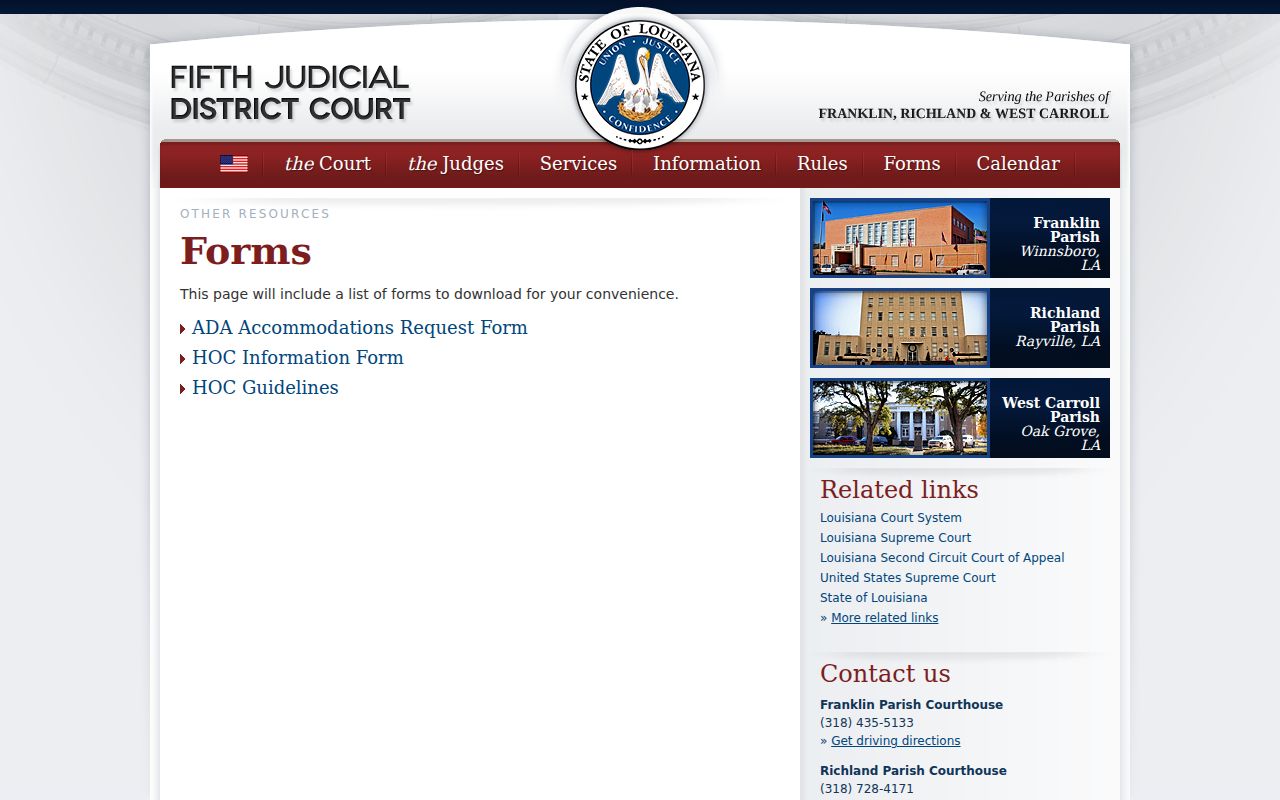
For its part, the Fifth Judicial District Court publishes accommodation forms and hearing-officer forms on its forms page. The page is a handy court source. It covers civil and domestic procedure.
Follow the court's current instructions. A docket label alone will not tell you which form applies, whose signature is needed, or what notice and filing steps a given Richland Parish case requires.
The official 5JDC forms page lays out the civil-process paperwork itself.
A docket line that names a local procedural step usually raises a question the forms can answer. Ask the Richland Parish clerk or the assigned division which form fits that case before you file anything.
Hearings on the Civil Docket
Civil settings come in several flavors. Motion hour, pretrial conferences, hearing-officer conferences, Rule to Show Cause hearings, trials, jury settings, and later resets all appear on the Richland Parish civil docket. Read each setting line against the case type and the division assigned to it. Ordinary civil matters follow a Monday and Thursday pattern. That pattern never replaces the domestic calendar. Protective-order hearings run on their own regular Friday schedule unless the court chooses a different date. For domestic cases, the official 5JDC page spells out the sequence. Contested cases generally need a pretrial conference with the assigned judge plus a Hearing Officer Conference. Scheduling help sits at (318) 728-4111. That page carries conflicting hearing-officer names, though. Confirm the current assignment by phone instead of trusting an old reference. Local rules and case orders also control verified income statements and any other dated deadlines.
Richland Parish Civil Docket Domestic Timing
Domestic cases in Richland Parish follow their own sequence. The local rules call for a pretrial conference, then a Hearing Officer Conference. A Rule to Show Cause or trial comes last where one applies. Timing rules matter here. The HOC must sit at least 10 days before a Rule to Show Cause or trial. Verified income statements have their own deadlines. They are due at least five days before a child-support trial or HOC. For scheduling, the official domestic page lists Robin Boutwell at (318) 728-4111. Hearing-officer contacts sit on the same line. That page shows inconsistent names in two spots. Confirm the current contact and the active order before relying on an older docket entry. Personal financial and child-related information can also limit which underlying materials are open to the public.
Richland Parish Civil Docket Copy Routes
Need a certified paper or a document the online record lacks? The Richland Parish Clerk of Court civil division handles those requests. The courthouse sits at 708 Julia Street, Suite 103, Rayville, Louisiana 71269. Both divisions sit on the second floor. Mail goes to P.O. Box 119, Rayville, LA 71269. The official directory lists (318) 728-7000. It also lists fax (318) 728-7020 and richlandparishcc@bellsouth.net. A Records Document Request form is available. A quick call will confirm whether the clerk takes it in person, by mail, fax, or email. Ask for the narrowest item that answers your question. That could be a docket sheet, a judgment, an order, or a named filing. The clerk's fee schedule lists $2 per page for ordinary copies. $3 covers conformed or stamped copies. Certification charges vary by department and document. Those copy fees are separate from advance deposits and filing charges. Before planning a courthouse terminal search, call ahead about terminal access. The clerk's published hours run Monday through Friday, except legal holidays. Hours are 8:30 a.m. to 4:30 p.m. A phone call can also tell you whether the file is imaged and which delivery method the office accepts. The clerk's directory line settles any question when listed numbers differ.
Who Can See Civil Dockets
Louisiana's public-record baseline comes from Louisiana R.S. 44:1, though exceptions and confidentiality rules can still limit what a court releases. Remote access works differently. The statewide framework sits in R.S. 13:754, which also lets the system charge user fees. Pricing for eClerksLA and the exact reach of its Richland Parish civil docket records sit behind a login, so treat both as unconfirmed until the clerk's office states them.
Access is record-specific. Public docket events can exist without public document images. Domestic, adoption, protected-person, juvenile, sealed, and expunged material may have added limits. Ask for a public or redacted version when one is available, and do not treat an omitted entry as a reason to bypass a confidentiality rule.
Appeals take you to a different shelf. The Second Circuit keeps its own record system for cases that leave the parish, and PACER covers federal matters in the Western District of Louisiana. Neither one replaces a Richland Parish civil docket or the case file held by the parish clerk, so search each office for its own piece of the lawsuit.